
Why Time Sync is Key to Financial Sector Quantum Safety
Financial institutions are always handling time-sensitive transactions so accurate synchronisation is not a convenience but a basic infrastructure. They spend millions optimizing their networks to shave microseconds off transaction times, relying on highly synchronized master clocks and time servers to ensure every trade, transfer, and ledger entry is logged in the exact right order. The master clock is the heartbeat of that infrastructure. Get it wrong by even a millisecond and the entire record of what happened, and when, becomes unreliable.
But it is facing a new, existential threat to its security: the quantum computer. It is advancing rapidly, and when these machines fully mature, the mathematical puzzles that currently protect our VPNs, banking apps, and data centers will be solved in seconds.
Harvest Now, Decrypt Later: The Attack Already Targeting Your Data
Hackers are currently executing “Harvest Now, Decrypt Later” attacks (a threat documented by security researchers and the US Federal Reserve). They are siphoning encrypted data from telecom backbones and banking networks, storing them and once quantum computers are viable, they will unlock those files.
What most institutions haven’t considered is that the same encrypted files contain timestamps generated by their Network Time Protocol infrastructure. If those timestamps are ever shown to be inaccurate because the time server feeding them was compromised or misconfigured then the evidentiary value of every record in that archive collapses.
Especially for institutions handling corporate mergers, central bank reserves, or long-term wealth management, data stolen today will still be highly damaging when decrypted five or ten years from now. Regulators including Monetary Authority of Singapore (MAS) are increasingly flagging quantum readiness as a forward-looking risk management priority so financial institutions here cannot afford to wait for a breach to happen.
Two Quantum-Safe Encryption Approaches Financial Institutions Are Adopting
Upgrading infrastructure to be “quantum-safe” is rapidly shifting from a theoretical tech project to a strict compliance mandate.
Post-Quantum Cryptography (PQC): PQC uses new mathematical algorithms that are secure against quantum computers.
Quantum Key Distribution (QKD): This method sends encryption keys using actual photons (light particles). It observes whether a photon changes its state, the key is corrupted, and the intrusion is detected instantly.
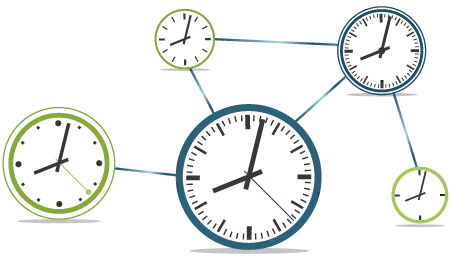
Why Quantum-Safe Security Depends on Nanosecond-Accurate Time Synchronisation
Most quantum-safety conversations focus on the algorithm but very few address the timing infrastructure underneath it. In a quantum-safe world, time synchronisation is not optional, it’s foundational.
QKD systems require precise time synchronisation between sender and receiver so errors of even a few nanoseconds can cause photon detection to fail and corrupt a key exchange! If a bank’s time servers are off by even a fraction of a nanosecond, the arrival time of each photon cannot be measured accurately, and the security handshake fails.
But the challenge doesn’t stop there. Attackers already target time synchronisation because disrupting a bank’s master clocks can cause trading algorithms to crash, logs to become unreliable, and transaction records to fail. In a quantum-safe future, time synchronisation protocols themselves, must be protected using post-quantum cryptography. The clocks must be secured with the same rigour as the data they help timestamp.
Because if your clocks are wrong, your encryption is worthless.
