

Guide to Hospital Clock System and Time Server Explained
Researchers checked the clocks in emergency departments and ambulances. Out of 11 devices in the ED, only TWO were showing the correct time. The biggest gap between two devices? 19 minutes and 5 seconds. ⏰
A difference of a few minutes rarely changes immediate patient treatment on the spot. The real damage is to the medical record itself. Emergency timelines, legal reviews, incident investigations, and clinical research only work when every single timestamp can be trusted 100%.
What Unsynchronised Hospital Clocks Do to Records and Handovers
Hospitals literally run on timestamps. A medication round, an operating theatre start, a code call, and a handover note all rely on an accurate clock.
At the same time, hospitals host dozens of independent time sources. Wall clocks, bedside monitors, defibrillators, phones, electronic health record systems, CCTV, and door access controls all keep their own time by default. Unless someone deliberately builds a system to connect them, none of them will agree.
This difference of a few minutes rarely changes immediate patient treatment decisions options but it causes real damage to the medical record itself. It completely breaks the medical records for emergency timelines, legal reviews, and even incident investigations! These are all only trustworthy when every timestamp can be trusted 100%.
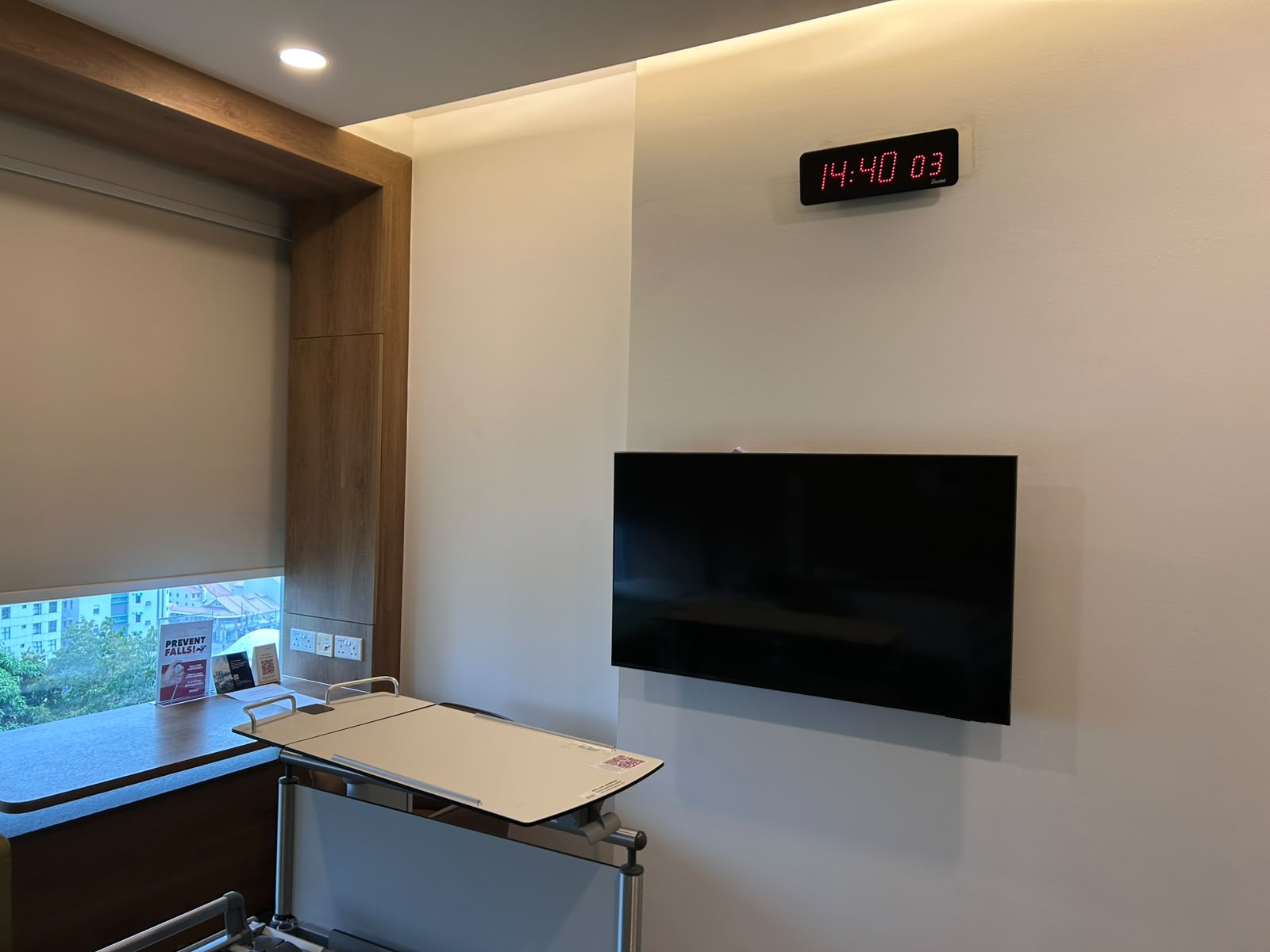
Time Server, Slave Clocks and NTP in a Hospital Clock System
Hospitals need a unified clock system, a source of truth. It starts with a time server syncing to GNSS satellites (atomic clocks in space! 🛰️) and sharing that time over the hospital network using NTP. Network clocks then sync up using Power over Ethernet (PoE), a one cable for power AND time.
From there, it broadcasts that exact time across the hospital network using Network Time Protocol (NTP). Network clocks, servers, CCTV, and door access systems all sync to it automatically. Clocks that follow the central time server are called slave clocks.
Did you know? Healthcare is recognized as one of Singapore’s Critical Information Infrastructure (CII) sectors. Under ISO 27001 Annex A (Control 8.17), organizations are required to synchronize their information system clocks to approved reference time sources. A central NTP time server is the standard way to meet this requirement.
3 Questions to Ask Before Choosing Your Hospital Clocks
Before picking a synchronized clock system for your facility, keep these three key evaluation criteria in mind:
- Does the clock sync directly from our central time server over the network (NTP/PoE)?
- What happens to the display and accuracy if the network connection drops?
- Does the physical casing and mounting suit the room’s environment (especially for sterile operating theatres or cleanrooms)?
