

How Singapore Train Network Does Real-Time Packet Capture
Every day from 5:30 AM to midnight, Singapore’s mass transit network serves as the country’s central operational pulse, carrying millions of commuters across the island. On a high-frequency urban rail system where trains arrive every few minutes, network reliability is directly tied to national mobility.
When a train network of this scale experiences a disruption, the impact is immediate and widespread. Banking, retail, tourism, and emergency services all depend on the reliable movement of people across the island. A single delay can ripple through the entire system, affecting thousands of commuters.
But most passengers never see what happens behind the scenes to keep things running.
Modern trains are no longer just mechanical cars but rolling data hubs running complex, closed LAN networks for automatic train control (ATC), passenger information systems, CCTV surveillance, and operational telemetry. Managing network health across hundreds of active trains simultaneously across the country is a monumental task. This is where onboard network monitoring and real-time packet capture become essential. Standard tools were not built for an environment where the device you are monitoring is travelling at speed between stations.
Network Monitoring Challenges Inside Singapore’s MRT Trains
High-Density Operational Demands:
Operating continuously from early morning to midnight leaves virtually zero maintenance windows during the day. Transit operators need network troubleshooting tools that can detect network anomalies in real time while trains are fully operational on the tracks. Without them, a fault can go undetected for entire service days before engineers find it during the narrow three-hour overnight maintenance window.
Transient Latency & Signaling Drops:
Microsecond delays or buffer overflows in automated signaling loops can trigger emergency train brakes. Network teams must instantly troubleshoot latency and isolate whether an issue stems from physical cable noise, hardware failure, or protocol misconfigurations. This kind of network forensic analysis requires packet level data. Without a full record of what was on the wire at the moment of the fault, root cause analysis becomes guesswork.
SMRT is increasingly using technologies like AI and automation to detect potential faults early and prevent them from disrupting commuter journeys. AI can process large volumes of maintenance and operational data to detect subtle signs of degradation. This enables engineers to fix issues before faults happen. Through JARVIS, maintenance teams can search for fault histories, retrieve repair procedures and receive AI-guided troubleshooting steps all through a conversational interface
Packet Capture and Remote Troubleshooting on Singapore’s MRT
So what does all this have to do with remote network monitoring?
Everything.
But engineers can’t always be physically present on the trains due to their constant movement.
Without remote capture and analysis capabilities, engineers may miss crucial data points and have to restart tests, leading to added costs, delays, and inefficiencies
Intelligent platforms like Jarvis process large volumes of operational and maintenance data to flag subtle signs of degradation, even allowing engineers to query repair procedures through a conversational chatbot interface.
In April 2026, SMRT announced JARVIS, an AI maintenance platform built by its engineering arm STRIDES Technologies with Oracle. Phase 1 launched in January 2026 across the North-South and East-West Lines. It brings together 38 years of operational and fault data into a single platform. Engineers use a natural-language chatbot to search fault histories and retrieve repair procedures. JARVIS can geo-tag faults to specific equipment, so engineers go directly to the right location during the overnight window. It has already triggered more than 500 preventive maintenance inspections.
But JARVIS is only as accurate as the raw packet data feeding it. That data has to come from somewhere. Getting it reliably off a moving train without disrupting safety systems is the challenge that dedicated diagnostic hardware solves.
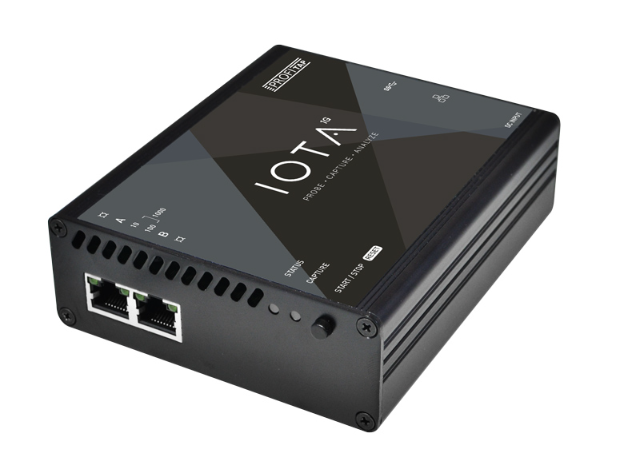
To ensure no critical traffic is missed, dedicated diagnostic hardware like the compact Profitap IOTA 1G M12 sits directly on the train’s internal network wires. By passively capturing full line-rate packet data without disrupting safety control loops, this reliable and non-intrusive data collection can perform accurate root-cause analysis.
Beyond fault diagnosis, passive packet capture also enables security monitoring at the network layer. Engineers can check for unauthorised devices, protocol anomalies and traffic patterns that should not be there. Traffic optimization becomes possible too. Identifying which applications consume the most bandwidth on each train helps operators plan network resources more efficiently.
Giving central engineering teams instant remote access to real-time packet data without ever stepping onto a moving train? This seamless edge visibility turns every transit car into a fully observable asset. It ensures that potential network anomalies are resolved quickly to keep Singapore’s rail system running punctually.
